Powdered Metal Rods: What are they? Why are they a problem? And how to check for them.
Posted by Adam Blattenberg on Oct 5th 2025
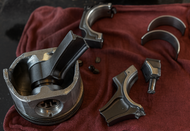
Let’s talk about Powdered Metal Rods, or PMR’s as they’re more commonly called. If there’s one thing that causes the most damage to the 7.3L Powerstroke in one shot, the PMR is it. When these connecting rods fail they often punch holes in the engine block, requiring a whole new engine be built. So what is a PMR exactly? What year 7.3’s had it? And how do I check if my 7.3 has PMR’s? Let's dive in.
What’s a PMR?
While many rods used in the automotive industry are forged (especially diesel rods), PMR’s are constructed using a powdered metal mix of iron and other metals. This mix is poured into a form, which is then compressed. Once the compression is complete, the pressed part is transferred to a furnace where the particles are fused metallurgically, creating a solid, dense part. From there they go into machining and eventually into the engines they were made for.
The reason this way of manufacturing was used comes down to cost. PMR’s are much less expensive than forged rods, and the consistency in manufacturing is much better. And believe it or not, they’re not as scary as you’d think. PMR’s are used all over the automotive industry, and most live very happy, long lives. For the 7.3, as long as you’re not adding a turbo and bigger injectors, more often than not, the engine performs great with them. Now of course, many have failed on stock trucks, but generally, it’s once you approach that 400hp mark that things go wrong.
Affected Years
Not every 7.3 came with PMRs, and there are plenty of exceptions to the timelines we’re about to lay out. The only way to know for certain is to check your engine directly—we’ll cover how to do that next. If you own an OBS and still have the original engine, you’re in the clear; those were all forged. The Super Duty trucks are where things get tricky. For the most part, 2001–2003 model years are where you’ll find PMRs, but it isn’t a clean cutoff.
- Early 2001 model year (with a build date before October 2000) usually had forged rods.
- Those with a build date after October 2000, generally switched to PMRs.
- Mid-2001 saw a short run of forged rods again, before going back to PMRs through the end of production.
How to Be Sure
There’s a couple of ways to check. First, by the engine serial number, which can be found on the drivers side valve cover. And the hands-down best way, is by physically looking inside the engine via an inspection port (easier than it sounds).
1. Engine Serial Numbers
- 1,425,746 and prior are forged
- 1,425,747–1,440,712 are PMR
- 1,446,713–1,498,318 are forged
- 1,498,319 and after are PMR
2. Looking Inside
On the rearward side of the oil filter housing, just an inch or two back, you’ll see two plugs in the block. Removing one will allow you to look inside. The top one is in a coolant gallery; don’t pull it, the one we’re looking for is the lower of the two. To remove it, you’ll need a 5/16inch square drive socket. Since most of us don’t have a square drive tool set lying around, you can use a piece of 5/16 square stock available at most hardware stores, or even a T47 Torx bit will work in a pinch (assuming the plug isn’t seized in the block). Remove the plug and have a look inside the block. On the bottom of the rods, if you see a bolt head, that’s a PMR. If you see a nut on a stud, that’s a forged rod.
Here's a decent video on the inspection process:
Lead image courtsey of Green Handle Media: https://greenhandlemedia.com/