
How to Test a 7.3L Powerstroke Glow Plug Relay
Oct 23rd 2026
Quick Answer:
With the relay energized, check voltage at the two large posts.
Battery voltage going in, but little or no voltage coming out means the relay is bad. Better yet, measure voltage drop across the two large posts. More than roughly 0.5 volt difference under load points toward worn relay contacts.
But, let's go a little more in depth. It's not always as simple as replacing the GPR.
Note: General electrical knowledge is necessary here. Do not attempt if you're not familiar with 12V systems and especially, a multimeter.
Common symptoms include:
- Long crank when cold
- White smoke while cranking
- Rough running for the first few seconds
- Starts much easier when plugged in
- No noticeable electrical load when the key is turned on
The relay's job is simple. The PCM commands it on, the relay closes, and battery power is sent to all eight glow plugs.
The important part is testing it under load. A relay can click and still be bad.
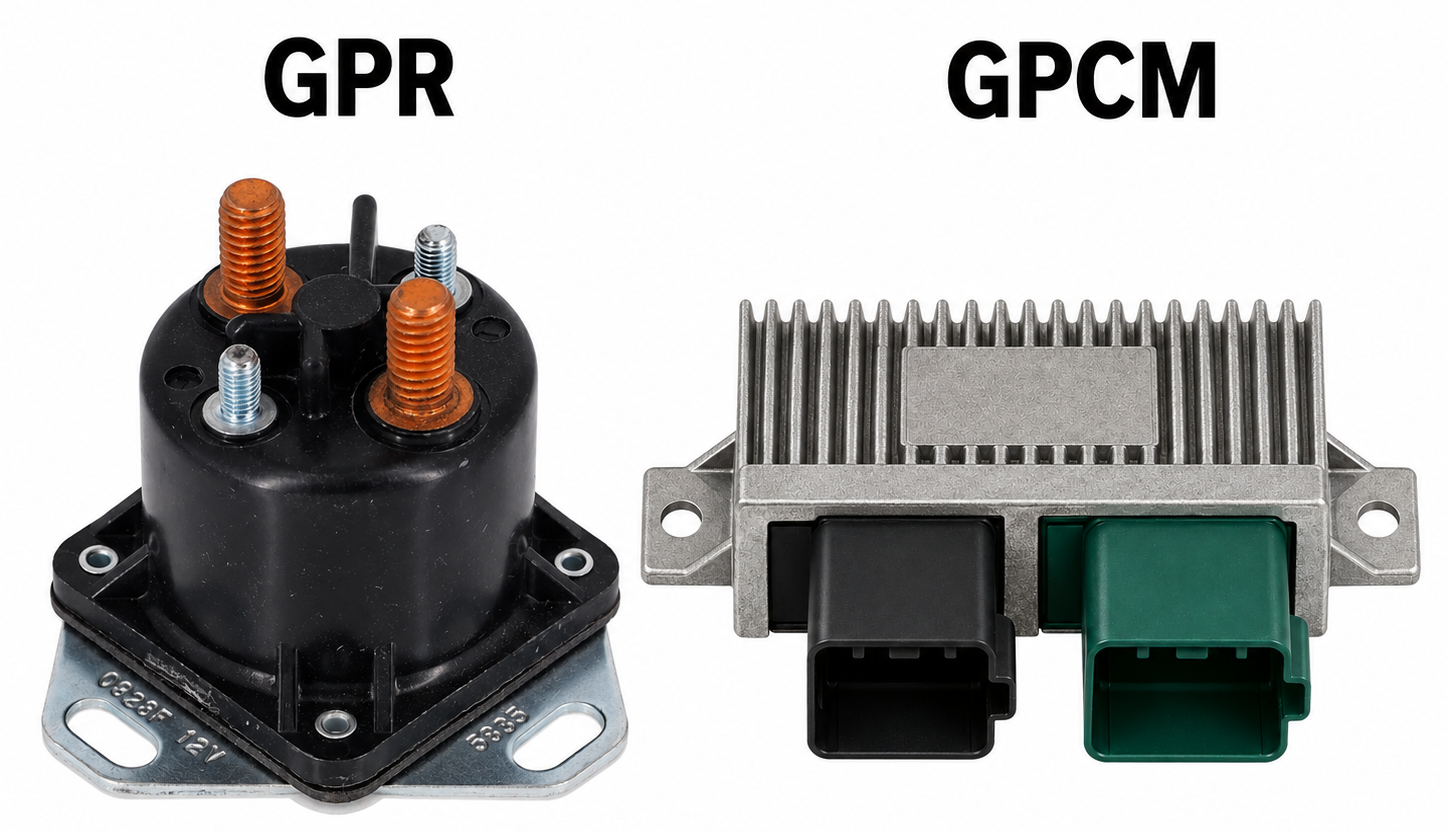
First, Make Sure You Actually Have a GPR
Most 1994-2003 7.3L Powerstrokes use a conventional glow plug relay.
Some late 1999-2003 California-emissions trucks use a Glow Plug Control Module, or GPCM, instead. Those trucks require a different diagnostic procedure.
On later trucks, don't confuse the glow plug relay with the intake-air-heater relay sitting nearby. They look very similar, potentially the same if they've been relpaced, but the IAH relay will have a large wire leading directly to the IAH on the intake spyder.
The Two Large Posts
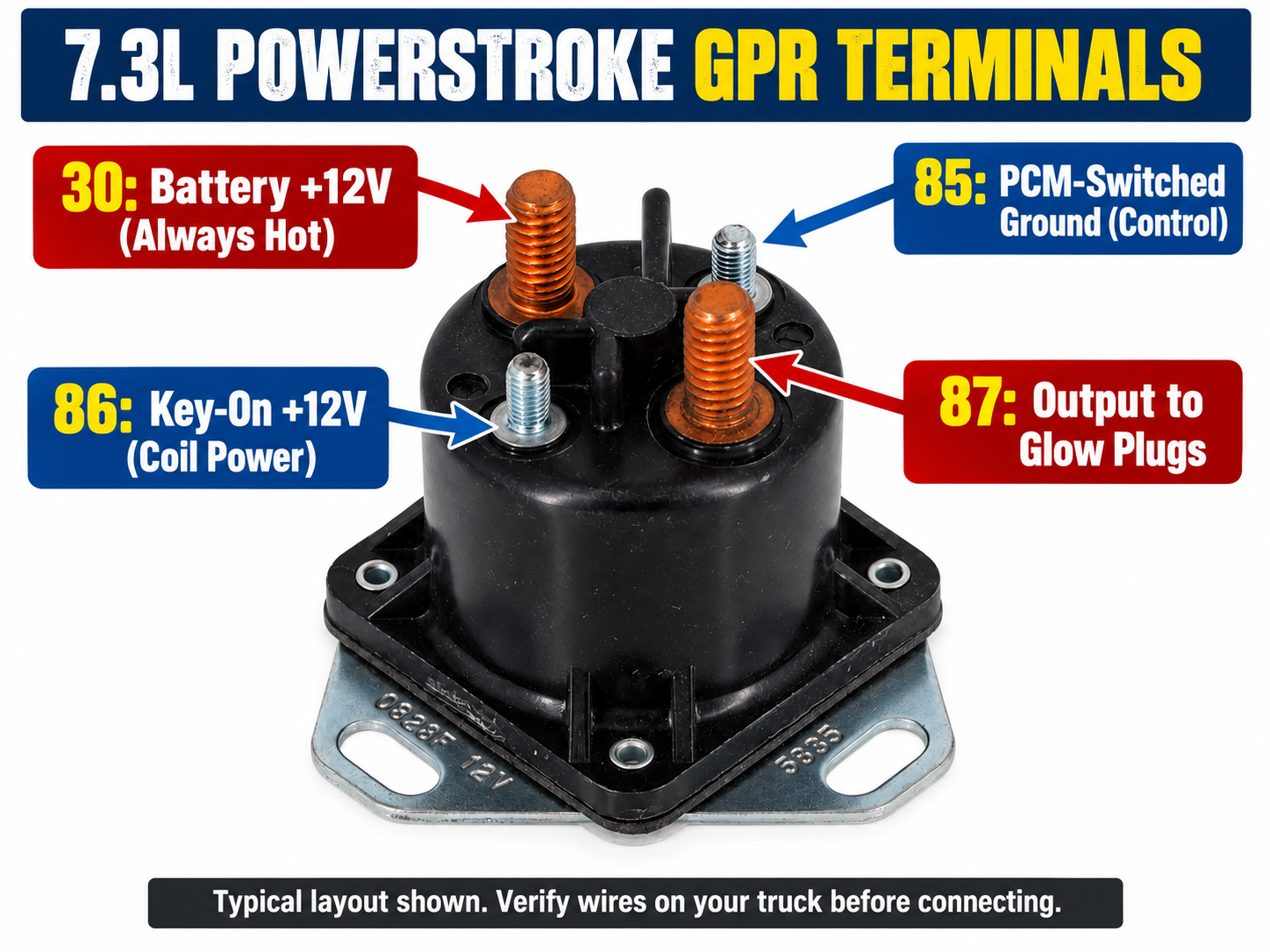
The easiest place to start is with the two large terminals on the relay. One is the battery feed. The other sends power to the glow plugs when the relay closes.
Key Off
Put your multimeter on DC volts.
Ground the black lead and check both large posts.
One should have battery voltage all the time.
The other should have little or no voltage with the relay off.
If the supply post has no power, the problem is upstream of the relay.
Turn the Key On
Do this with the engine cold.
The PCM should command the glow plug relay on. You should hear a solid click.
Now check the output-side large terminal.
Ford/Navistar's 7.3L diagnostic information calls for more than 10 volts at the relay output while the glow plugs are operating.
Battery Voltage In, No Voltage Out
If the relay has good battery voltage on the input side, is being commanded on, but has little or no voltage on the output side, the relay is bad. Simple as that.
The Better Test: Voltage Drop
This catches weak relays that still appear to work.
Put one meter lead on each large relay terminal while the relay is energized. Test individually. You're now measuring the voltage being lost inside the relay.
A good relay should show very little difference between the two posts. Ideally you're looking for only a few tenths of a volt.
If you're losing around half a volt or more across the relay, the internal contacts are getting resistive and we'd replace it.
This is the failure that gets missed.
The relay clicks. Both terminals show voltage. But the burned internal contacts can't carry the 100-plus amps the glow plugs need.
Why a Test Light Can Fool You
A test light can tell you that power is present. It can't tell you how well the relay carries current. A worn relay may light a test light just fine and still drop too much voltage when eight cold glow plugs come online. For a GPR, a multimeter voltage-drop test is much more useful.
Check the Two Small Terminals
If the relay doesn't click at all, move to the control side.
The two small terminals operate the relay coil.
On the conventional 7.3L relay:
- One side receives key-on power
- The PCM grounds the other side to activate the relay
If the relay has the proper power and PCM ground across the small terminals but doesn't close, the relay itself has failed.
If one of those signals is missing, don't replace the relay yet. Diagnose the control circuit.
An Easy Way to Force the Relay On
A warm engine can make relay testing confusing because the PCM may decide the glow plugs aren't needed.
Here's a shortcut:
With the engine off, disconnect the Engine Oil Temperature sensor, then turn the key to RUN.
The PCM sees the missing temperature signal as a cold condition and commands the glow plug relay on for roughly two minutes. It will also set an EOT-related code, so clear that afterward.
Don't Use the Wait-to-Start Light as Your Timer
The dash light and glow plug relay aren't the same circuit. The Wait-to-Start light can turn off while the PCM continues powering the glow plugs.
So don't assume the relay turned off just because the light went out. Measure voltage at the relay.
Check Total Current Draw
If you have a DC amp clamp, this is another useful test.
A healthy 7.3L glow plug system will typically pull roughly 120 to 150 amps when the plugs are first energized. Current falls as the plugs heat up. (dieselhub.com)
If the relay output voltage is good but total current is much lower than expected, start looking at:
- Failed glow plugs
- Burned valve-cover connectors
- UVCH problems
- High-resistance wiring
At that point the relay may be doing its job.
P0380 Code
On relay-equipped trucks, P0380 indicates a problem with the glow plug relay control circuit. That doesn't automatically mean the relay's high-current contacts are bad. The problem can also be in the coil circuit, wiring, or PCM control side.
This is another reason to test both the large power terminals and the small control terminals before buying parts.
Quick Diagnostic Guide
No battery voltage at the large input post: Check the power feed and fusible links.
Battery voltage in, relay commanded on, no voltage out: Bad GPR.
Voltage out, but large voltage drop across the relay: Burned or resistive GPR contacts.
No relay click and no control signal: Check PCM command, key-on power, wiring, and EOT input.
Good relay output but weak overall current draw: Check glow plugs, UVCH, and valve-cover connections.
The Bottom Line
The fastest way to test a 7.3L glow plug relay is to check the two large posts while the relay is under load.
You want battery power going in, more than roughly 10 volts coming out, and very little voltage difference across the relay itself.
And don't assume a relay is good just because it clicks.
We've seen plenty that click perfectly and still don't carry enough current to get eight glow plugs hot.
For replacement, we carry the Motorcraft Glow Plug Relay / GPR, F81Z-12B533-AC, for 1994-2003 7.3L applications.
Disclaimer: The information provided on this blog is for informational purposes only. We share our knowledge and experience, but we are not liable for any damages, injuries, or losses that may occur as a result of using this information. Situations are rarely cut and dry in the automotive world. Your situation will likely be somewhat different than what we describe here. Use your best judgment and always consult a qualified professional for automotive repairs and modifications. Your safety is your responsibility.