

99-03 7.3 Powerstroke Coolant Filtration: Full Step by Step How To
Nov 13th 2025
Full PDF Instructions can be downloaded here: https://www.riffraffdiesel.com/content/RESOURCES/RDP%20Coolant%20Filter%20Installation.pdf
Parts Link: https://www.riffraffdiesel.com/riffraff-diesel-coolant-filtration-system-filter-kit-99-03/
Required Parts:
- Donaldson coolant filter
- Billet coolant filter head
- Coolant filter bracket
- Outlet hose with tee fitting
- Inlet hose
- Spring band hose clamps
- Temperature sensor port allen plug
- 2 Ball valves
- 2 Allen bolts
- 2 Washers
- Tube of Gasoila® thread sealant
Recommended Tools: Basic hand tools
IMPORTANT: Before starting installation, please be sure that all items which were supplied with the kit are accounted for.
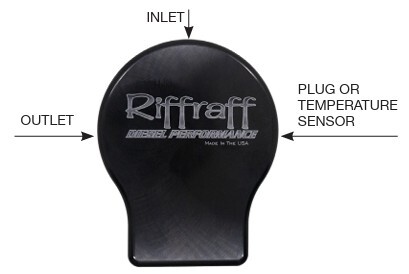
1. WARNING: Never work on a vehicle that has been driven recently. The coolant system is pressurized and contains hot liquid. Allow sufficient time for the vehicle to cool before working on the coolant system.
2. Disconnect batteries for safety.
3. Open the petcock at the bottom of the radiator to drain coolant and reduce coolant loss during installation.
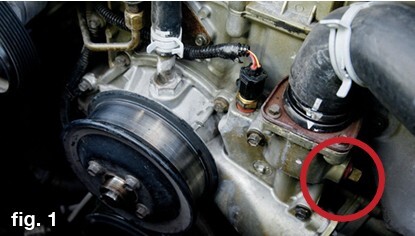
4. Remove the plug from the side of the water pump housing at the upper radiator hose neck to drain coolant. The coolant filter inlet hose will connect to this port in step 10. (fig. 1)
5. Remove the jacking tools from the top of the radiator.
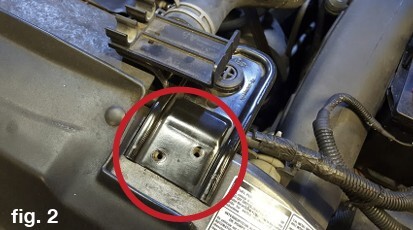
6. Remove the two bolts from the driver’s side radiator bracket and remove the bracket and rubber isolator from the radiator. Set aside bolts and isolator for reuse in step 12. (fig. 2)
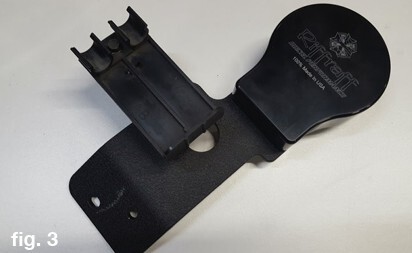
7. Remove the plastic tool holding clip from the radiator support bracket and transfer to the new support bracket using existing hardware. Do NOT over-tighten. (fig. 3)
8. If you are not using an aftermarket coolant temperature sensor, apply Gasoila® thread sealant to the allen plug provided and install into the coolant filter head on the side closest to the battery. (fig. 4)

9. Apply Gasoila® to the threads of the smaller fitting on the coolant filter inlet hose (longer included hose) and thread the fitting into the coolant filter head on the side facing the firewall. Once snug, tighten fully with a wrench.
10. Apply Gasoila® to the threads of the remaining fitting on the hose connected to the coolant filter head. Thread this fitting into the water pump housing port from which coolant was drained in step 4. Turn the coolant filter head to thread it in properly. Once snug, tighten fully with a wrench.
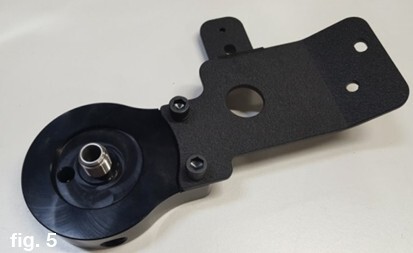
11. Using the provided allen head bolts (2) and washers (2), assemble the coolant filter head to the support bracket as shown. (fig. 5)
12. Insert the rubber radiator isolator into the coolant filter radiator support bracket and install onto the radiator using existing hardware.
13. Install the provided coolant filter onto the filter head. Apply a small amount of coolant to the o-ring on the filter for lubrication.
14. Apply Gasoila® thread sealant to the inlet hose with the “tee fitting” and insert into the coolant filter head facing the degas bottle. Tighten the hose while noting the tee fitting orientation. The tee fitting needs to align with the degas bottle hose. (see step 8, image figure 4 above)
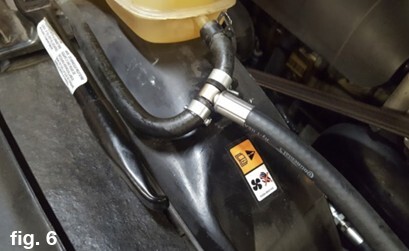
15. Cut the degas bottle hose in the U section to allow the tee fitting to be inserted.
16. Slide one of the provided hose clamps onto each side of the cut degas bottle hose. Insert the tee fitting ends into the degas bottle hose and tighten clamps to secure the fitting into the hose. (fig. 6)
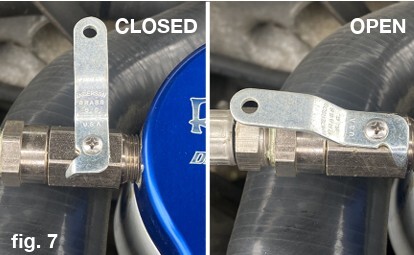
17. Open up the ball valves at the coolant filter head. (fig. 7)
18. If you are using an aftermarket coolant temperature sensor, insert it into the remaining port on the filter head using thread sealant. (fig. 8)

19. Re-connect the batteries.
20. Refill the degas bottle with the correct coolant of your choice.
21. Start the vehicle and check for leaks.
22. After several minutes of running, you should see coolant entering the degas bottle via the degas bottle hose. As RPMs are increased, coolant flow will increase.