
7.3L Powerstroke IDM Failure: Symptoms, Codes, and Diagnosis
Sep 17th 2026
A 7.3L Powerstroke can have great fuel pressure, good ICP, a perfectly good cam sensor, and pretty much everything else in good working order, and still not start. When this happens, it’s time to start looking at the Injector Driver Module, or IDM. Here, we’ll touch on some of the most important and most common things that will help diagnose an IDM issue. There’s a lot to cover, so we can’t go in depth with each, but this’ll get you pointed in the right direction.
Note: A quality scan tool is your best friend here. We recomend AutoEnginuity
Quick and Dirty, How It Works
The PCM tells the IDM when and how long each injector needs to fire. The IDM generates the high voltage required by the HEUI injector solenoids, then controls each injection event through the injector high-side and low-side circuits.
Common IDM Failure Symptoms
A failing IDM can cause:
- Crank/no-start
- Intermittent no-start
- Rough idle
- Misfires
- One or more dead cylinders
- Dead injector bank
- Sudden loss of power
- Stalling
- Failed injector buzz test
- P1298 and/or P1316 codes
Keep in mind, an IDM doesn't always quit completely. Internal faults can affect individual injector circuits or an entire bank.
Water Is a Big One
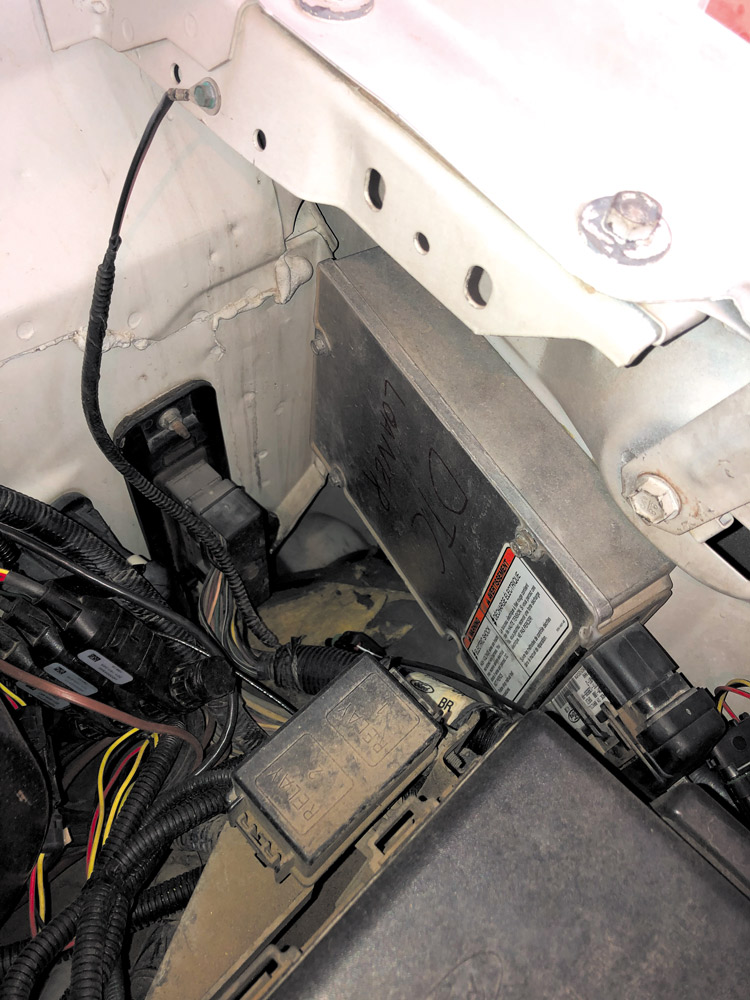
Water intrusion is one of the most common IDM failure causes. The IDM case is vented, and moisture can enter the module and corrode the circuit board. Things like a wet floorboard on the drivers side, peeling paint around the cowl, or especially corrosion or water staining on/around the IDM, are all things that may point to water intrusion.
Common Associated Codes
P1298: IDM Failure
P1298 points directly toward an IDM fault. There is one important exception: Ford issued TSB 99-13-2 for certain 1998/1999 E-Series and 1999 F-Series trucks built through April 12, 1999. Low battery voltage could cause those IDMs to falsely set P1298 because of internal circuit tolerances.
On those trucks, verify battery voltage and rerun the self-tests before condemning the IDM.
For any 7.3L, checking battery condition and cranking voltage is still part of a good diagnostic process.
P1316: IDM Codes Detected
P1316 means the IDM has detected injector circuit faults and has additional codes stored. It does not automatically mean the IDM is bad.
Important: Do not clear P1316 before retrieving those codes. Once they're erased, you've thrown away some of your best diagnostic information.
Injector Circuit Codes
Codes P1271 through P1278 indicate a high-to-low-side open circuit for cylinders 1 through 8.
Codes P1261 through P1268 indicate high-to-low-side short faults.
Neither automatically condemns the IDM.
Possible causes include:
- Injector solenoid
- Under-valve-cover harness
- Valve-cover gasket connector
- External engine harness
- IDM issues
If four injectors on the same bank show faults, start looking at that bank's wiring.
Bank-Level IDM Codes
- P1291: Bank 1 high side shorted to ground or battery voltage
- P1292: Bank 2 high side shorted to ground or battery voltage
- P1293: Bank 1 high side open
- P1294: Bank 2 high side open
- P1295: Multiple Bank 1 injector faults
- P1296: Multiple Bank 2 injector faults
- P1297: High sides shorted together
- P1298: IDM failure
Always check the wiring before condemning the module for most of these faults.
Run an Injector Buzz Test
The KOEO (Key On Engine Off) Injector Electrical Self-Test is one of the quickest ways to narrow down an IDM problem. Unlike newer vehicles where you can check contribution rates to test injectors, this is the only way with a 7.3. It must be done with a quality scan tool, although custom tools for performing the procedure also exist. With a scan tool, all eight injectors will first buzz together for approximately two seconds. The IDM then fires cylinders 1 through 8 individually for roughly one second each.
Listen or watch for:
- One injector missing
- Weak or different sounding injector
- Entire bank missing
- Test that aborts
- Codes generated during the test
A bad buzz doesn't automatically mean a bad injector. You're testing the injector and the electrical circuit feeding it.
Don't Forget the UVCH
Before replacing an IDM, check the Under Valve Cover Harness, valve-cover pass-through connections, and external wiring. A UVCH problem can kill one injector, several injectors, or an entire bank. A short in the injector wiring can also damage a replacement IDM.
Fastest Diagnostic Order
1. Read the Codes - Retrieve P1316-related IDM codes before clearing anything.
2. Check Cranking Data - A 7.3L generally needs approximately:
- 10.5 volts absolute minimum supply to the IDM
- 100 RPM minimum
- 500 PSI ICP
- Valid injector pulse command
Note: If RPM or ICP is missing, diagnose that system before blaming the IDM.
3. Run the Buzz Test - Note weak, missing, or dead-bank injector responses.
4. Inspect the IDM - Look for water intrusion and connector corrosion.
5. Check Injector Wiring - If the codes identify one injector or one bank, inspect the valve-cover connections and UVCH. Look for shorts to ground, power, or to each other.
6. Clear and Retest - Once you've recorded everything, clear the codes and rerun the injector self-test. If the same fault immediately returns, you're dealing with a current problem instead of an old stored fault.
The Bottom Line
P1298 points toward the IDM. P1316 tells you to keep diagnosing.
If P1316 is present, retrieve the IDM codes and run the buzz test. One-cylinder or one-bank faults should send you toward the injector wiring before the module.
If power and grounds are good, the injector circuits test correctly, and P1298 or an IDM-related failure continues to return, then the IDM moves to the top of the list.
And before installing another IDM, make sure a shorted injector circuit isn't what killed the first one.
Disclaimer: The information provided on this blog is for informational purposes only. We share our knowledge and experience, but we are not liable for any damages, injuries, or losses that may occur as a result of using this information. Situations are rarely cut and dry in the automotive world. Your situation will likely be somewhat different than what we describe here. Use your best judgment and always consult a qualified professional for automotive repairs and modifications. Your safety is your responsibility.