What's the right type of sealant to use? Stop asking the question... just read this.
Nov 6th 2025
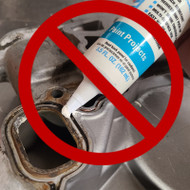
Room Temperature Vulcanizing sealant (aka RTV), or any other type of sealant usage is somewhat of a mystery for most of us. It's ok, you don't need to admit it, but we've all been guilty of rolling the dice at the parts store at least once, hoping it'll do the job. RTV comes in many formulas, and they're all designed to do a specific job. Use the wrong one and at the very least, you'll run into sealing issues, throwing all that work you just did out the window. On top of that, using the wrong type of sealant can kill fuel systems, damage engine internals (due usually to oil contamination), and cause excessive oil foaming. So let's talk about the most common uses for RTV and the different types available for each, but first let's mention when not to use it. You should never use RTV, no matter the brand, on items such as HPOP or oil cooler mounting gaskets, fuel system fittings, exhaust up-pipes, etc.
Engine Oil Pans, Front Cover, Rear Main Seal and Other Metal-to-Metal Oil Sealing Areas
Proper Type: Oil-resistant, sensor-safe silicone like Ultra Grey, Ultra Black, or OE-specific RTV (like our favorite, International T-442 RTV Silicone)
These types of sealants are used on oil pans, HPOP reservoirs, timing covers, and half-moon seals—anywhere a gasket ends or a part must be sealed without one. It’s also used where small casting imperfections could allow leaks. The proper RTV is crucial, and the factory options listed are best as they are proven to not cause the oil to foam when it comes into contact with it.
Water Pump and Thermostat Housings
Proper Type: Coolant-resistant, non-corrosive RTV such as Permatex Water Pump & Thermostat RTV (Blue or Grey).
Oil-rated or copper RTVs don’t adhere properly to coolant-wetted surfaces. The correct sealants handle both pressure and chemical exposure to coolant.
Fuel Systems
Proper Type: Fuel resistant types. Such as Permatex Aviation Form-A-Gasket or Loctite 518 Anaerobic Gasket Maker
Fuel systems should NEVER use standard RTV silicone. Gasoline, ethanol and diesel dissolve most silicone-based sealants. Even the smallest contaminants can damage fuel systems, and leaks are serious fire hazards, so always use the correct sealant. That being said, on the Powerstroke there is very little reason to ever use RTV on your fuel system connections.
Intake and Exhaust Systems
Proper Type:
-
Intake Plenums: International T-442 RTV Silicone, or Motorcraft TA-31.
-
Exhaust: Ultra Copper or specialized high-temp RTV rated for 1000°F minimum.
On intake plenums, RTV seals small imperfections, even slightly larger ones, well when used correctly. On exhausts, the latter two fill small imperfections that see constant thermal cycling. There again, on the Powerstroke exhaust and up-pipe system, there is no call to use RTV.
Transmissions
Proper Type: Oil-resistant RTV such as Permatex Ultra Black, The Right Stuff Black, International T-442 RTV Silicone
These sealants are formulated to resist ATF and gear oil, which can break down weaker silicones. They also maintain flexibility under high heat and exposure to transmission fluids. Last, they're designed to fill any small gaps between surfaces, which is ideal for transmission pan installations. It should be noted that on the Powerstroke transmissions which us a factory reusable pan gasket no RTV is needed or recommended.
Differential Covers
Proper Type: High oil resistance and high adhesion types—again, Ultra Black or The Right Stuff Black are ideal. Copper or “sensor-safe” RTVs are sometimes used in race differentials, but the black formulations are proven for street and heavy-duty use. On the Super Duty applications, we recommend going back with the International T-442 RTV Silicone that it came with from the factory.
Differential covers flex under load and temperature changes. The correct sealant will provide a flexible yet durable seal that handles expansion, vibration, and hot gear oil.